
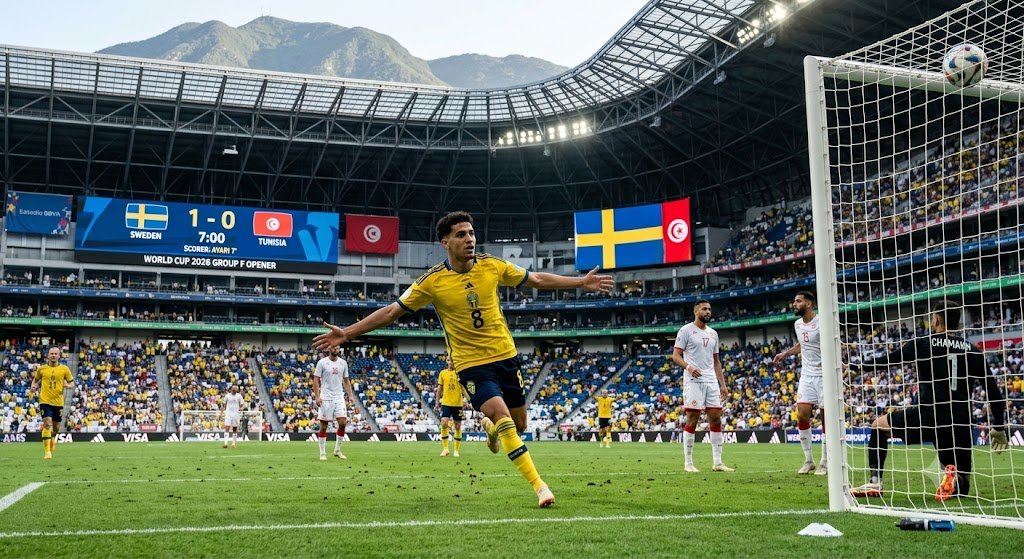
Yasin Ayari Picked The Country That Picked Him Back, 2026
Seven minutes in, Yasin Ayari hit a shot from 28 yards that had no business going in, and it told you everything about the choice he made years earlier. The Brighton midfielder has a Tunisian mother, but he chose to represent Sweden, the country of his birth. On June 15, 2026, in Sweden’s 5-1 win over Tunisia at Estadio BBVA in Guadalupe, Mexico, in their Group F opener, he scored twice against the nation he turned down. The second goal arrived in the sixth minute of stoppage time. Both were struck from distance. Both found the same corner.
Sweden beat Tunisia 5-1. Ayari scored in the 7th minute and the 90th-plus-6th. Alexander Isak, Viktor Gyokeres and substitute Mattias Svanberg also scored, with Svanberg’s goal arriving just 18 seconds after he stepped onto the pitch, the second-fastest substitute goal in World Cup history. Tunisia’s only reply came from Omar Rekik’s header in first-half stoppage time.
There is no hiding from a decision like Ayari’s. Players who qualify for two countries get asked about it for the rest of their careers, and the question only gets louder when the two countries end up sharing a group at a World Cup. Ayari answered it the only way that actually settles the matter.
His first goal came from a loose ball after Tunisia failed to deal with a long ball over the top. Goalkeeper Mouhib Chamakh beat Alexander Isak to the through ball, Gyokeres’ follow-up was blocked, and the rebound fell to Ayari outside the box. He did not need a second invitation. Right foot, high into the corner, 0.20 expected goals on target from a shot worth just 0.05 in pure expected goals. The placement did the work the position never should have allowed.
Tunisia clawed one back before halftime through Rekik, and for a stretch it looked like a contest again.
Sweden kept scoring anyway. Isak made it two on the half-hour mark, Gyokeres added a third just after the hour, and then Svanberg’s instant impact off the bench turned the result from a job done into something closer to a statement.
Then, in the dying seconds, Ayari got one more chance to make his night personal. Lucas Bergvall, on as a substitute himself, won the ball high up the pitch and slid it into Ayari’s feet. One touch to settle, then a venomous strike into the far corner. Chamakh did not move. It was the same idea as his first goal, executed from almost the identical spot on the pitch, as if the whole night had been building toward a kind of symmetry nobody scripted.
Five goals, an expected goals tally of just 1.33. Sweden were efficient in a way the numbers cannot fully explain, and Ayari was the player who made sure nobody would spend the next two days arguing about which country deserved him more.
Somewhere in Tunisia, people will have watched those two finishes and wondered what their attack could have looked like with him in it. Sweden will not waste time wondering. They already know.