
Vinicius Junior Saved Brazil From Embarrassment, Not From a Reckoning
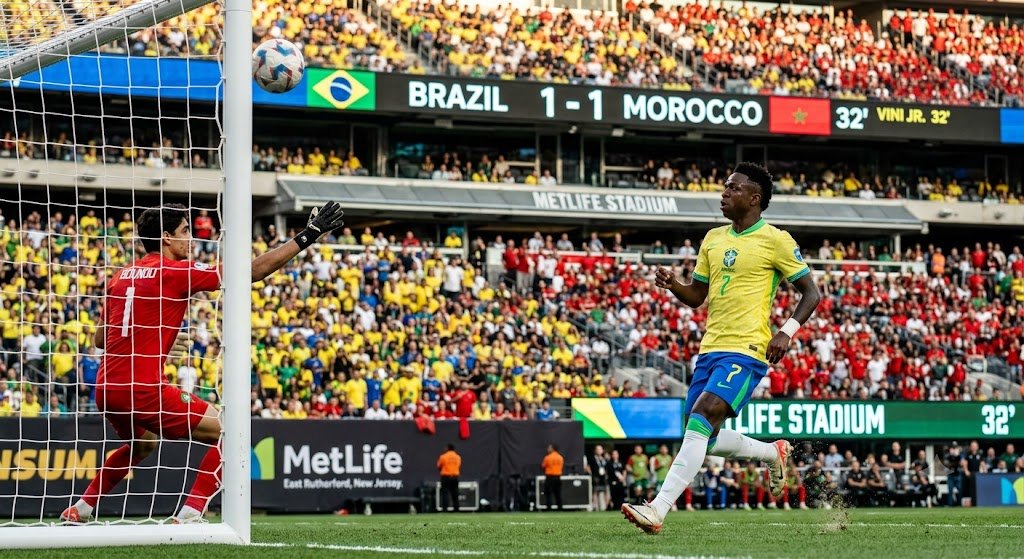
Bruno Guimaraes found him on the left side of the box, and for a brief second Vinicius Junior had Noussair Mazraoui to beat and an angle that did not look like a goal. Then it was. Vinicius Junior scored Brazil’s equalizer against Morocco in the 32nd minute, cutting in from the left and curling a right-footed finish over Yassine Bounou’s outstretched hand at MetLife Stadium in East Rutherford, New Jersey, on June 14, 2026, in a Group C World Cup opener that finished 1-1.
It was his tenth international goal, and the only thing on the night that went entirely to plan.
Here is the headline version, since the rest gets complicated fast. Brazil drew Morocco 1-1. Ismael Saibari put Morocco ahead in the 21st minute, chipping over a slow-reacting Alisson Becker after a sharp move down the right. Vinicius leveled it eleven minutes later. Neither side found a winner across ten added minutes of stoppage time, and Yassine Bounou denied Brazil twice in the closing exchanges to protect the point.
Vinicius did not have a quiet night before that goal. He had touched the ball fifty-three times, more than any other Brazil attacker, and looked the one player on the yellow shirts willing to run directly at defenders rather than work around them. Still, Brazil’s first half had been shapeless. Lucas Paqueta lost a routine pass from Roger Ibanez inside his own half, it bounced off Bilal El Khannouss, and within four passes Saibari was running clean through Gabriel Magalhaes and Marquinhos to chip the goalkeeper. Carlo Ancelotti, watching in a three-piece suit in 88-degree heat, had little time to react before his team was behind.
Vinicius answered quickly. He exchanged passes with Guimaraes, took two touches to open the angle, and hit it before Mazraoui could close him down. The finish carried 0.54 expected goals on target from an original shot worth just 0.08, the kind of gap that separates a clean strike from a half-chance.
That contrast matters more than the scoreline lets on.
Brazil finished with 1.26 expected goals to Morocco’s 1.37, a near dead heat that flatters neither team’s case for moral victory. Morocco, ranked seventh in the world and a semifinalist four years ago, were the sharper side for long stretches and pushed Brazil to the brink in stoppage time through Neil El Aynaoui and substitute Ayoube Amaimouni, both denied by Alisson. Vinicius, by contrast, barely featured again after the half hour mark. He won three duels and completed enough passes to stay involved, but the explosive carries that defined his goal mostly dried up as Morocco’s double pivot of Azzedine Ounahi and Ayyoub Bouaddi shut down the spaces around him.
Make no mistake, this was Vinicius doing exactly what a five-time champion needs from its most dangerous forward: bailing out a sloppy collective performance with one moment of individual quality. It does not erase the fact that Brazil were second best for large parts of ninety minutes against a team many had pegged as inferior on paper.
Neymar did not even dress, still recovering from a torn calf, which left Vinicius as the closest thing to a genuine difference-maker in yellow. He delivered when it mattered most and then mostly faded from view, a tension the team around him will need to resolve before the stakes rise.
Brazil’s unbeaten run in World Cup openers stretches to twenty-one matches now, a streak dating back to 1934 that says more about history than about Saturday’s performance. Vinicius extended it with the kind of strike that ends up on year-end reels regardless of what comes next.
What it did not do was answer the larger question hanging over this Brazil side: whether one moment of brilliance from their best player is a foundation or a crutch. Against Haiti and Scotland, in Philadelphia and Miami Gardens, nobody will be asking Vinicius to bail anyone out again. Whether he has to is the story that actually matters.