
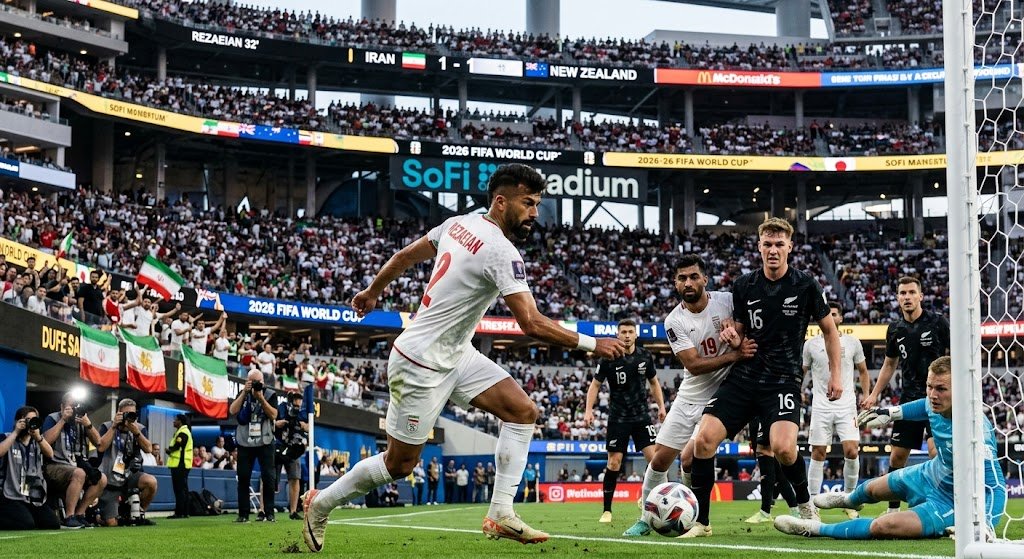
Ramin Rezaeian Carried Iran Through Every Ninety Minutes, 2026
A right back is not supposed to be the player a team cannot survive without. On June 16, 2026, at SoFi Stadium in Inglewood, California, Ramin Rezaeian scored one goal and set up another as Iran fought back twice to draw 2-2 with New Zealand in their Group G opener at the 2026 World Cup. He did not just contribute. He was directly involved in both of Iran’s goals on a night his team needed every ounce of him.
Iran and New Zealand finished level at 2-2. Elijah Just put New Zealand ahead in the 7th minute and added a second in the 54th. Rezaeian leveled it himself in the 32nd, then teed up Mohammad Mohebbi for the equalizer in the 64th. Two goals, two different roles, one player at the center of both.
This was not a normal night for Iran to be playing football at all. The team had spent months dealing with the fallout of a war involving the United States and Israel, forced to relocate training from the US to Mexico, with eleven non-playing staff blocked from entering the country for matches. None of that showed in Rezaeian’s performance, which is itself worth sitting with for a moment.
His goal came from instinct as much as anything scripted. New Zealand defender Finn Surman denied Shahriyar Moghanloo’s shot, but the loose ball rolled straight into Rezaeian’s path. He had continued his run forward in hope of exactly this kind of second chance, the give-and-go that never quite arrived but left him perfectly placed anyway. He poked it home from eight yards, an expected-goals-on-target value of 0.78 confirming what the eye already knew: that was a chance any forward in the building would have buried.
New Zealand responded. Just doubled their lead early in the second half, finishing a flowing team move that left Iran needing an answer fast.
They got one from the same player who started the comeback.
In the 64th minute, Saman Ghoddos switched the play wide. Rezaeian settled it with one touch and immediately whipped a cross toward the edge of the six-yard box, finding Mohebbi completely unmarked. The header went in off the foot of the post. Rezaeian’s fingerprints were now on every goal his team had scored that night.
There is a tendency to talk about fullbacks purely in terms of defensive duels and recovery runs. Rezaeian spent this match doing both of those things while also being Iran’s most dangerous attacking outlet from open play. He finished with more touches in advanced positions than nearly anyone else on the pitch, and the data back it up: an expected-goals contribution that outpaced what most attacking players managed across the full ninety minutes.
Mehdi Taremi, Iran’s captain and the player who carried 49 percent of the team’s goal involvement during qualifying, struck the post early on and never quite found his rhythm against a well-organized New Zealand back line. It did not matter. Rezaeian filled the gap that night, turning a deficit into a draw not once but twice.
By full time, Iran had earned a point against a team many had expected them to beat comfortably. The goal involvement numbers tell their own story. Rezaeian: one goal, one assist, a combined expected goals and expected assists tally higher than any teammate’s. Strip away the context of the war, the relocated training camps, the protests inside the stadium itself, and you still have a fullback who single-handedly authored both halves of his team’s comeback.
Somewhere in Los Angeles, in a stadium filled with both supporters waving the pre-revolution Lion and Sun flag and others booing the anthem before kickoff, a defender who was never supposed to be the headline kept finding his way back into the story. Iran’s World Cup begins with a draw they should be relieved to have. It begins, too, with a quiet reminder that sometimes the player holding a team together is not the captain or the striker, but the one running the same flank for ninety-six unforgiving minutes and refusing to stop.