
Messi’s 20th World Cup Goal Nearly Was Not Enough in 2026
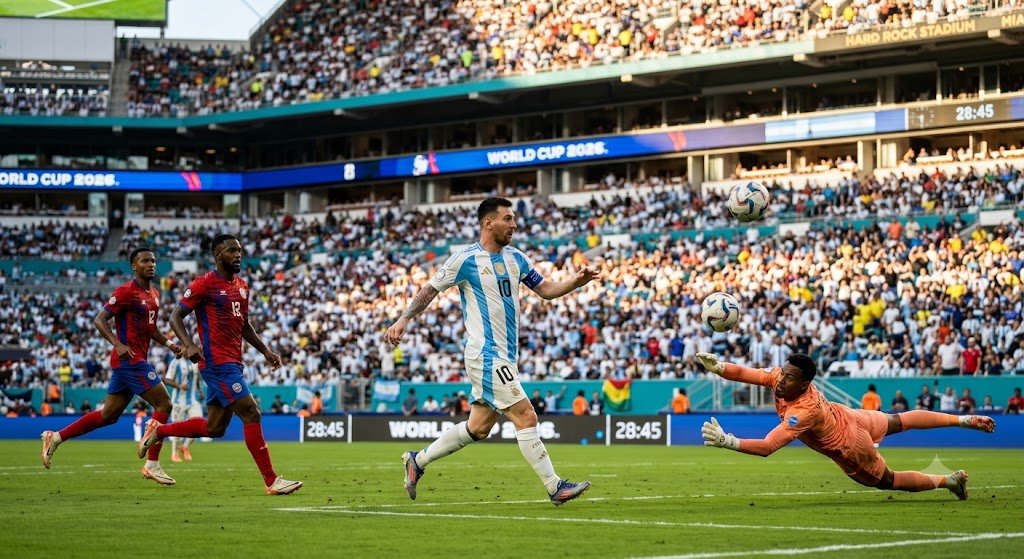
Lionel Messi had one touch to work with, and he barely needed it. Lisandro Martinez floated a long ball over Cape Verde’s back line in the 29th minute, and Messi glided clear of two defenders without breaking stride, took the ball down mid-run and lifted it past Vozinha for the opener. Argentina beat Cape Verde 3-2 after extra time on July 4, 2026, at Hard Rock Stadium in Miami Gardens, in a Round of 32 match at the World Cup. Nobody inside the stadium that night expected the underdogs to make it this hard.
Here is the short version. Messi scored in the 29th minute, Deroy Duarte equalized for Cape Verde in the 59th, Lisandro Martinez restored the lead two minutes into extra time, Sidny Lopes Cabral answered with a stunning curler in the 103rd, and a deflected Cristian Romero header off Diney Borges settled it in the 111th. Messi finished with six shots on target, the most he has managed in any of his thirty World Cup appearances.
Everyone will remember the final scoreline as another routine step for the champions.
That is not what happened here.
Argentina were 84 percent favorites before kickoff. By halftime, with Messi’s goal standing alone, that number had climbed past 93. Then Cape Verde spent the next ninety minutes making Scaloni’s side look ordinary, matching one of the best teams in the world stride for stride from a country that had never played a single World Cup match before this tournament.
This was Messi’s 20th World Cup goal, stretching his own record further clear of Kylian Mbappe. It also extended his scoring streak to eight straight World Cup appearances, a run now worth twelve goals. Somewhere in the second half he passed both Mbappe and Pele for total direct goal involvements in World Cup knockout matches, a number most players never sniff across an entire career. None of it changed how close this one came to going the other way.
Cape Verde were toothless for twenty minutes.
Then Ryan Mendes found space on the right, Deroy Duarte arrived at the near post from an impossible angle, and suddenly the crowd of 64,478 went from comfortable to nervous. Messi kept testing Vozinha through the second half, drawing a string of saves from the 40-year-old goalkeeper, who finished the night with eight stops in normal time and ten overall. Truth is, without Vozinha standing on his head repeatedly, this match ends in ninety minutes.
Extra time only raised the stakes. Alexis Mac Allister flicked a corner toward the near post, Martinez could not quite reach it with his head, so he adjusted and smashed it into the top corner instead. Two minutes later, still buzzing from that finish, Argentina found themselves level again inside a heartbeat. Cabral drove infield from left-back, opened his body and curled a shot into the top corner that will be replayed for years regardless of who wins this tournament. Make no mistake, that goal deserved to settle a different kind of match.
It fell to Romero in the end, glancing home a Messi corner that clipped Borges on the way through. An own goal decided it, but the header and the delivery both belonged to Argentina’s biggest names, and Cape Verde’s World Cup dream ended one grim deflection short of penalties.
Messi walked off having taken more shots on target in a single World Cup game than at any point in his career, at 39 years old, in front of a stadium that came to watch him cruise. He did not cruise. He had to be at his sharpest for two hours against a team ranked 63rd in the world, one that had already knocked Spain out of top spot in its group and drawn with Uruguay along the way.
Argentina move on to face Egypt in Atlanta, and Scaloni will know exactly what almost happened here. Cape Verde go home unbeaten in regulation time across four matches at their first World Cup, and somewhere on that island tonight, nobody will remember this as a loss.