
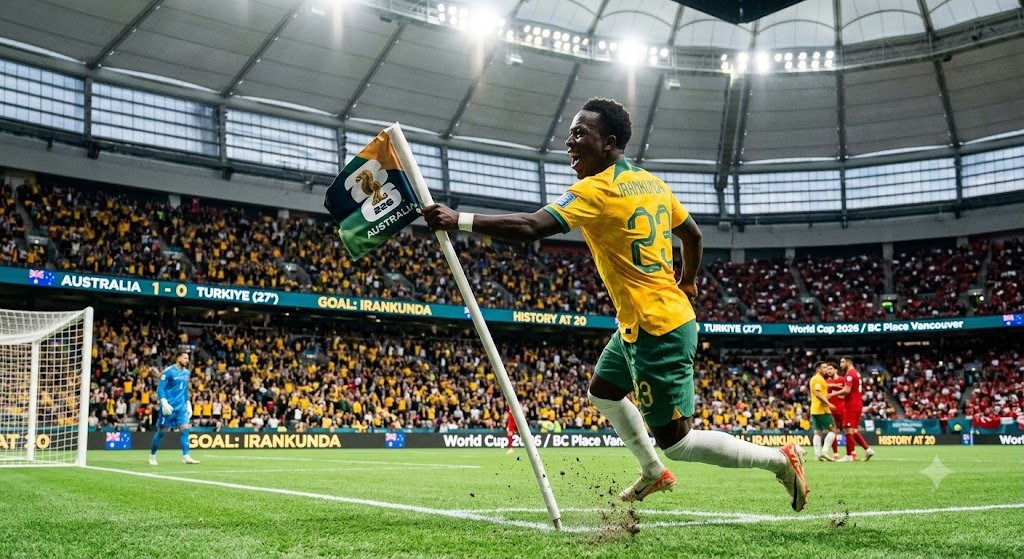
Nestory Irankunda Punched a Corner Flag and Made History at 20
Three Turkiye defenders had him surrounded near the edge of the box, and Nestory Irankunda shot anyway. The ball beat Ugurcan Cakir low to his left in the 27th minute, and Irankunda wheeled away to punch the corner flag, a tribute to Tim Cahill that turned a teenage Watford winger into Australia’s youngest-ever World Cup goal scorer. Nestory Irankunda scored Australia’s opening goal as the Socceroos beat Turkiye 2-0 at BC Place in Vancouver on June 14, 2026, in their Group D opener at the World Cup.
It was the kind of moment Australian football had been waiting on since long before Irankunda was born.
Here is the result laid out plainly. Australia beat Turkiye 2-0. Irankunda opened the scoring in the 27th minute with a low finish from sixteen yards while three defenders closed him down. Connor Metcalfe doubled the lead in the 75th minute after pouncing on a loose ball from Ismail Yuksek’s turnover. Patrick Beach made eight saves at the other end, the most by an Australian goalkeeper in a single World Cup match, to protect the clean sheet through six minutes of stoppage time.
Irankunda is twenty. He plays his club football for Watford, a level below where Turkiye’s attacking talent operates, with Arda Guler at Real Madrid and Kenan Yildiz at Juventus sitting on the other bench. None of that mattered for the moment the goal arrived. Paul Okon-Engstler found him with a pass that split defenders, and Irankunda took it in stride rather than settling first, firing it low past Cakir’s left hand before the third covering defender could close the angle.
The shot carried 0.40 expected goals before contact and 0.82 once it left his boot, the kind of jump that separates a clean strike from a half-chance.
Make no mistake, this was not a flukey deflection or a moment of fortune. Irankunda took the ball under pressure, in a crowded space, and still found the only gap available.
Turkiye, back at a World Cup for the first time in twenty-four years after missing five straight tournaments, dominated the underlying numbers for long stretches. They finished with 1.36 expected goals to Australia’s 1.18 and held seventy-two percent possession, peppering Beach with thirty shots across the match. Guler alone tried nine efforts from distance, none finding the corner. Hakan Calhanoglu rattled a free kick that Beach turned away in the 86th minute, by which point the Socceroos goalkeeper had already produced the kind of night that will get replayed on Australian television for years.
Irankunda did not see the finish. He was substituted in the 61st minute for Nishan Velupillay, his work for the evening complete, and watched from the bench as Metcalfe added the second that put the result beyond doubt.
Three years ago, Australia exited the group stage at the last World Cup before falling to eventual champions Argentina in the round of sixteen. This time they sit level with co-host United States at the top of Group D, a position built in large part on one finish from their youngest scorer in tournament history.
He cannot control what Turkiye and the rest of this group do next, and a tougher test awaits against the Americans in Seattle on Friday. For one night in Vancouver, against three defenders who thought they had him covered, Nestory Irankunda made sure his name would be the first line of Australia’s World Cup story.