
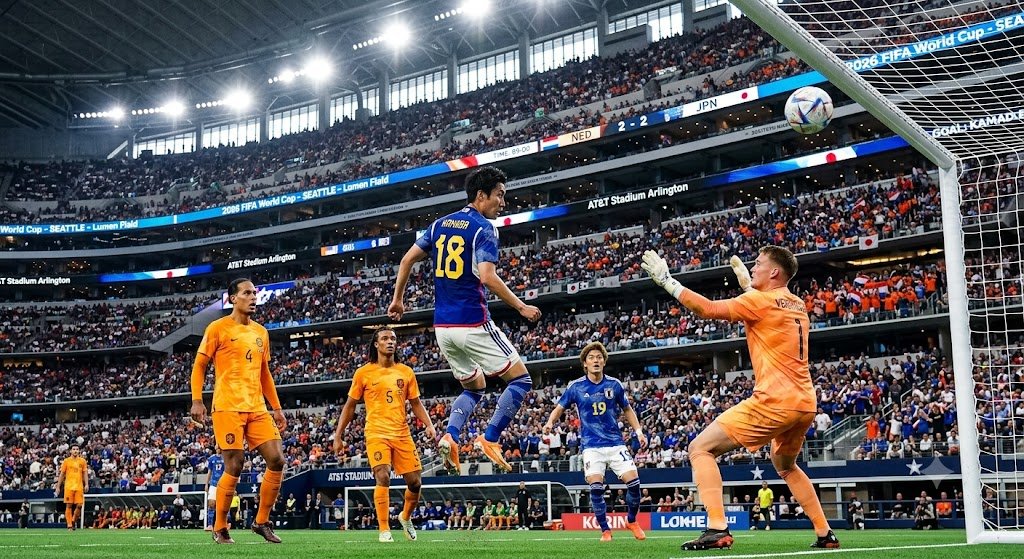
Daichi Kamada Headed In a Goal He Never Saw Coming
Koki Ogawa rose first. The ball was already flicked on, already moving toward a second contact nobody in orange had accounted for, when Daichi Kamada arrived to send it past Bart Verbruggen and into the top right corner. Daichi Kamada scored Japan’s stoppage-time equalizer as Japan drew 2-2 with the Netherlands at AT&T Stadium in Arlington, Texas, on June 15, 2026, in their Group F World Cup opener. It came in the 89th minute, with three points already slipping through Japan’s fingers for a second time.
Here is the scoreline in full. Netherlands led twice, through Virgil van Dijk’s header in the 51st minute and Crysencio Summerville’s curling finish in the 64th. Japan answered both times, first through Keito Nakamura in the 57th minute, then through Kamada at the death. The match finished 2-2, each side claiming a point that felt earned and stolen in equal measure.
Kamada had not been the headline name through most of the night. He played the full ninety minutes in central midfield, completing passes and doing the unglamorous work that rarely shows up in a highlight reel, his expected goals tally sitting at a modest 0.14 before the 89th minute arrived. He has built a career on exactly that kind of contribution, a player whose value often gets measured in spaces created rather than goals scored, currently plying his trade in Belgium after a wandering few seasons through Germany and England.
None of that mattered once Junya Ito swung in the corner.
Ogawa, only on the pitch himself as one of five substitutes Hajime Moriyasu had thrown on in search of an equalizer, rose above the Dutch defense and nodded the ball not toward goal but onto Kamada’s head instead, a connection that required split-second anticipation from both players. Kamada did not need to generate much power. He simply directed it, and Verbruggen could only parry a ball already past the point of saving, watching it cross the line for Japan’s second equalizer of the night.
That goal carried 0.66 expected goals on target from an original header worth just 0.14, the kind of gap that separates a desperate scramble from a finish a player will remember for years.
Make no mistake, Japan had no business being level at that point based on how the match had unfolded for long stretches. The Dutch held sixty percent of the ball and out-shot Japan on target six to three. Still, Japan kept finding answers, and Kamada’s presence in midfield throughout the second half had quietly helped sustain the pressure that eventually produced the equalizer.
The emotional arc of this match swung four separate times, and Kamada was on the pitch for every swing. He watched Van Dijk head Japan behind in the 51st minute off a Ryan Gravenberch cross, then helped orchestrate the buildup that led to Nakamura’s leveler six minutes later. He absorbed Summerville’s go-ahead strike in the 64th minute, a goal that cut in from the right and curled in off the post past Zion Suzuki. Through all of it, Kamada stayed on the field, working the same patient rhythm that has defined his international career, until the one moment where patience gave way to opportunism.
Ronald Koeman’s Netherlands had never failed to win a World Cup match after leading twice, a streak the commentary noted moments before Kamada ended it. That detail alone gives Saturday’s finish weight beyond the scoreline. Japan’s substitutions, all five used by the 84th minute, had been a gamble by Moriyasu to chase the game rather than protect a point, and it was Kamada, the deepest-lying of Japan’s attacking players, who turned that gamble into reward.
He has never been the kind of player who seeks the spotlight, and Saturday in Arlington did not change that instinct. He did not wheel away in delirious celebration the way a poacher might. He simply got swallowed by teammates near the corner flag, one contributor among many in a result built on five second-half substitutions and a refusal to accept defeat.
Three years from now, when people remember this Japan side and how its World Cup began, they may not immediately think of Daichi Kamada’s name first. They will think of the result, the late drama, the way Japan refused to lose twice in the same ninety minutes. But it was Kamada’s head that found the net when it mattered most, and on a night that demanded someone step forward in the final minutes, he did exactly that without ever needing to be the story.