
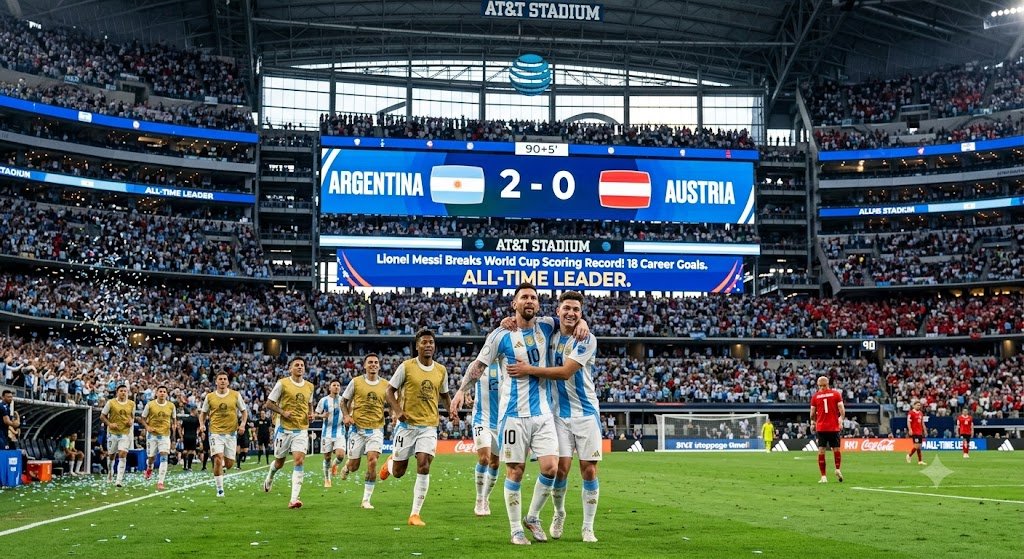
Lionel Messi Breaks World Cup Scoring Record in Argentina Win
Nine minutes in, Lionel Messi missed a penalty. He sent it wide right, low, nowhere near the corner he wanted, and for a moment the record looked like it might wait another day. It did not wait long. Messi scored twice as Argentina beat Austria 2-0 at AT&T Stadium in Arlington, Texas, on June 22, 2026, in their Group J match at the World Cup, and those two goals carried him past Miroslav Klose as the competition’s all-time leading scorer.
Argentina beat Austria 2-0. Messi scored in the 38th minute and again in the fifth minute of stoppage time, taking his career World Cup tally to 18 goals and moving him ahead of Klose’s mark of 16. The win sends Argentina through to the knockout rounds with a game still to play against Jordan.
Here is the thing Messi has spent two decades being measured against ghosts. Pele’s titles, Maradona’s genius, now Klose’s goals. At 38 years old, in what is almost certainly his final World Cup, he keeps closing the gaps one tournament at a time.
The penalty miss should have rattled him. It did not. Argentina kept working the ball through midfield, patient rather than panicked, and in the 38th minute Thiago Almada let a pass from Facundo Medina run through his legs and onto Messi’s left foot. Alexander Schlager, the Austria goalkeeper, leaned the wrong way. Messi did not need a second invitation. He slid the ball low into the bottom left corner from the edge of the box, the kind of finish that looks almost lazy until you remember how few players in the world can pick that exact corner under that exact pressure.
The celebration was muted. Messi has scored enough World Cup goals now that wild joy has given way to something closer to relief, then quiet certainty.
Truth is, the second half offered little to talk about. Argentina sat on their lead, content with 54 percent possession and 2.36 expected goals to Austria’s 0.53, while Austria pushed without ever truly threatening Emiliano Martinez’s goal. Marcel Sabitzer worked hard from deep, forcing one save before the hour, and Michael Gregoritsch headed a half chance off target in the 67th minute, but Austria’s best route to an equalizer always seemed to run through a set piece they never quite got right.
Then, deep into stoppage time, Messi delivered the moment that mattered more than the win itself.
Julian Alvarez had come on for Almada and combined with Messi down the left, slipping a through ball for the Argentina captain to spray wide. Alvarez’s first shot was saved by Schlager. The rebound fell loose. Messi arrived at the edge of the six-yard box, took one touch to set himself, and drove it into the center of the goal. Eighteen World Cup goals. Two ahead of Klose. Game, and a piece of history, both settled in the same instant.
Nico Williams and the rest of Argentina’s bench spilled onto the field. Messi did not run far before the celebration swallowed him.
Career context matters here, and it is worth sitting with for a moment. Messi missed his first three World Cups without lifting the trophy, carried Argentina to the final in 2014 and lost, then finally won it all in Qatar in 2022 with a tournament many called the greatest individual World Cup performance ever played. He came to North America in 2026 not needing to prove anything, and scored anyway, twice in this game alone, taking his tally to five goals from two matches in the group stage.
He also now holds the record for most World Cup wins as a player, 18, one more than Klose managed across four tournaments. Two records, one night, and Messi did not even need to say much about it afterward. The numbers did the talking, the way they so often have.
For all the credit Messi will collect, this Argentina side carried him efficiently rather than desperately. Cristian Romero went off injured in the 57th minute, Facundo Medina picked up a yellow card and a tactical withdrawal of his own, and Leandro Paredes was booked in stoppage time for a foul that summed up a second half played mostly on cruise control. None of it threatened the result. Argentina’s depth, much like their captain’s instincts, simply absorbed the disruption and moved on.
Austria, for their part, will round out the group against Algeria still needing something from that final match. Coach Ralf Rangnick made five substitutions trying to find an equalizer that never arrived, and his side’s xG of 0.53 told the real story of a contest Austria competed in without ever genuinely threatening to win.
What does a record like this mean for a player who has already won everything there is to win? Maybe not much, in the grand calculation of trophies and medals. But watch the way Messi turned away from goal in stoppage time, not raising his arms theatrically, just exhaling, and you understand that some numbers carry weight even for a man who has nothing left to prove. Klose held this record for over a decade. Messi now holds it with at least one more World Cup match guaranteed, and maybe, if Argentina go far enough in the knockout rounds, several more chances to extend it further still.